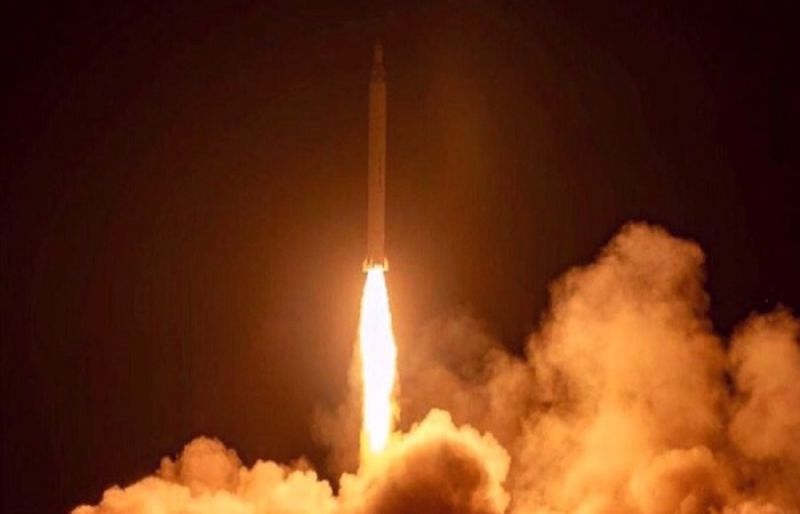
Iran's Armed Forces have announced new rounds of retaliatory operations against US military targets in the region featuring missile and drone strikes against facilities in Kuwait and Jordan following overnight US attacks on the Iranian coastline and southern cities.
The operations, which were carried out on Wednesday, were accompanied by a warning from the Islamic Revolution Guards Corps (IRGC) that, for now, Iran's reprisal remains focused on US offensive infrastructure in the region, but additional phases will follow.
‘Crushing blow’
Announcing its latest reprisal, the IRGC said that, during the eighth wave of its retaliatory Operation Nasr- (Victory) 2, its Navy and Aerospace Force carried out a combined missile-and-drone operation in response to “the enemy's attacks last night on locations along the country's southern coastline and in southern cities.”
According to the Corps, the operation targeted the early-warning radar of the C-RAM system at Kuwait's Ali al-Salem Airbase as well as “a gathering point of the criminal soldiers of the terrorist US army.”
Addressing the Kuwaiti people, the IRGC reminded that the United States was using the Arab nation’s territory to carry out unprovoked acts of aggression against Iran, urging the nation to “rid your country of the presence of these aggressors and, by fulfilling your Islamic duty, preserve your historical honor and dignity.”
Separately, the Army of the Islamic Republic said it had launched a drone strike against US military facilities in Jordan during the ninth phase of its retaliatory Operation Saeqeh (Lightning).
According to the Army's statement, loitering munitions targeted the fixed radar site, communications systems, and fuel depots of the US military at al-Azraq Airbase in Jordan. The statement described al-Azraq as a deployment site for missile defense systems and “one of the most important strategic and command centers for US forces operating in the West Asia region.”
The Army said the strike was carried out in retaliation for enemy attacks on parts of Iran, including the Bampur Army garrison in Iranshahr in the south, which led to the martyrdom of seven non-commissioned officers and soldiers of the Army’s Ground Force.
It condemned the enemy's “barbaric attacks” on military barracks in Iranshahr, saying such actions reflected the enemy's “inhuman nature.” Stressing that the attacks “will never be erased from the pages of history,” the statement added that Army personnel “will not retreat in the slightest from the honorable duty of defending the Iranian nation and the Islamic homeland or avenging the blood of the beloved martyrs.”
IRGC warns of further retaliatory phases
Meanwhile, commenting on the latest developments, IRGC spokesperson Brigadier General Hossein Mohebbi said the enemy should not expect to prolong the confrontation by turning it into a war of attrition.
"The enemy should not assume that it can sustain the current dynamics of the battlefield and turn the war into a war of attrition," he wrote in a post on X.
“Iran's operations are currently focused on destroying the US’s offensive infrastructure in the region. The next phases will then begin,” he added.
IRGC hunts down invading hostile drones
Separately, the IRGC announced that its air defense units had intercepted and shot down a US LUCAS unmanned aerial vehicle over the skies of Bandar Abbas in southern Iran. According to the Corps, the drone was detected by the country's integrated air defense network before being struck by a surface-to-air missile system.
In another statement, the IRGC also said one enemy MQ-9 drone was also intercepted and destroyed over the southern Iranian city of Andimeshk by an advanced air defense system of the IRGC’s Aerospace Force.
The United States has perpetrated numerous violations against Iranian territory since April 7, when US President Donald Trump announced a unilateral ceasefire in the latest bout of wholesale American-Israeli aggression targeting the Islamic Republic.
The violations continued even after Washington and Tehran signed a Pakistan-mediated memorandum of understanding last month, whose first clause clearly mandates cessation of aggression on all fronts.
The US has also been trying to help vessels evade the maritime route designated by the Islamic Republic for safe and legal passage through the Strait of Hormuz, by seeking to escort trespassing vessels through an illegal passageway.
Iran's Armed Forces have staged uncompromising retaliation in the face of each instance of violation, including those in support of illegal vessel movement in the Strait of Hormuz.