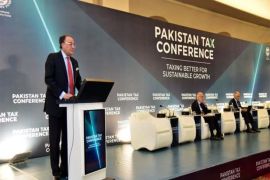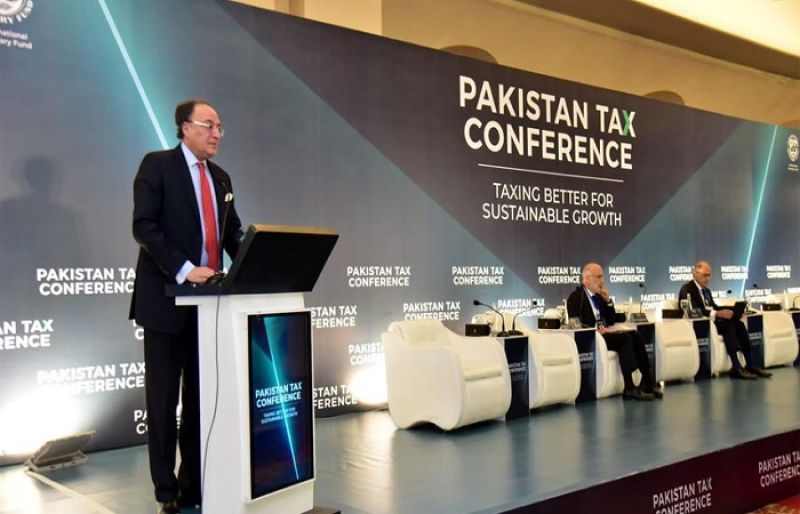
Finance Minister Muhammad Aurangzeb has reaffirmed the government’s commitment to sustainable and export-led economic growth.
He was addressing a workshop titled “Reforms for a Modern and Growth-Friendly Tax System” in Islamabad today.
The Finance Minister said Pakistan’s economic trajectory is moving in the right direction, emphasizing that the government would not allow the economy to slip back into the boom-and-bust cycle.
Muhammad Aurangzeb highlighted that Pakistan’s fiscal deficit is at a twenty-two year low and that the country has recorded primary surpluses for three consecutive years. He noted that the Federal Board of Revenue’s (FBR) tax-to-GDP ratio has increased from 8.8 percent to 10.3 percent, while tax revenues have grown by forty percent over the last two fiscal years.
The Finance Minister said taxation remained a critical component of the government’s structural reform agenda, alongside reforms in the energy sector, state-owned enterprises, privatization, public finance, pensions and tariffs. He said that an effective tax administration system would remain essential to enabling sustainable and high-quality economic growth.
Muhammad Aurangzeb said Pakistan’s foreign exchange reserves are at their highest level in the country’s history, providing cover for approximately three months of imports.
In his remarks, Jihad Azour, Director of the International Monetary Fund’s (IMF) Middle East and Central Asia Department, acknowledged that Pakistan has made significant progress toward achieving macroeconomic stability, rebuilding confidence, strengthening external buffers and supporting a gradual economic recovery. He said the next milestone is to translate this stabilization into stronger and more durable economic growth.
Jihad Azour said the IMF is committed to supporting Pakistan in building an economy capable of delivering a higher level of productivity led by the stronger private sector.