
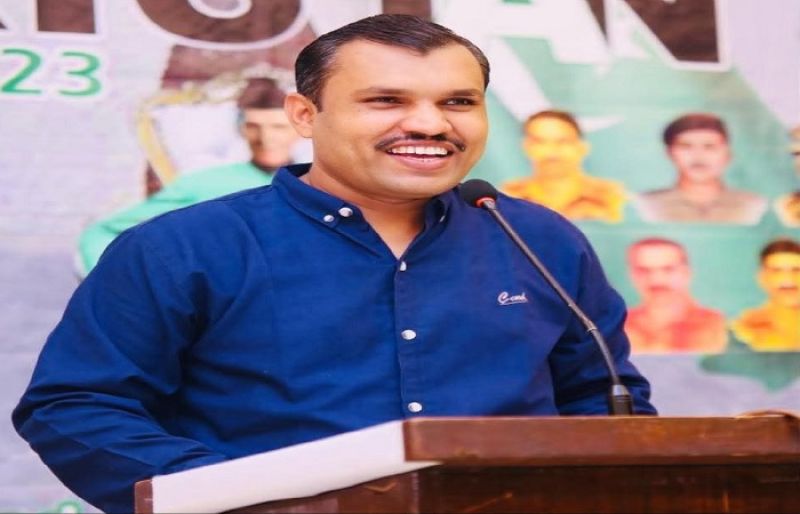
Music industries are rarely built in places like Khipro, a small town in Sindh’s Sanghar district with no major studio, label, or concert circuit. Yet Khair Muhammad Kumbher, now 33, went from a teenage self-taught producer there to Vice Chairman of the Pakistan United Music Producer Association (PUMPA), CEO of Sindh Distro, and Head of Operations of the Anti Music Fraud Task Force (AMFTF). His path offers lessons that reach well beyond one town.
Start with What You Have
In 2008, Khair Muhammad had a second-hand computer and a growing curiosity about how professional recordings sound full while his own sounded thin. He had no teacher and no proper equipment, so he learned editing, then mixing, then mastering, through downloaded software, slow-connection tutorials, and trial and error. Local singers let him work on their songs for free, and the results gradually spoke for themselves.
I did not set out to build an industry, he says. I set out to make one song sound right. Everything else came from refusing to stop.
Protect a Small Daily Habit
For about a decade, music was something that happened after hours. Khair Muhammad held a private job to support his family and returned to the computer each evening. It was a long time, and it was a hard time, he says. The habit he credits is modest: a single hour a night. Over the years, it gave him a detailed understanding of how recordings are assembled, knowledge that later proved more useful than any formal qualification.
Learn the Process from the Inside
When the pandemic arrived in 2020, he left his job and spent about two years freelancing in audio editing and voice-over work for clients he never met in person. For the first time, he earned international rates for skills built in Khipro, and he saw how the global creative economy runs on platforms, metadata, contracts, and payment systems.
He then released his own instrumental music, including the 2021 album 8th Night, partly to experience the release process firsthand. The lesson was that the real obstacle for artists is rarely talent or access. It is what happens after the upload. That insight led him to co-found Sindh Distro in 2023.
Build Structure Where There Is None
By 2025, it was clear that individual companies could only do so much. Pakistan’s independent music sector had no body to negotiate with streaming platforms, educate artists on copyright, or represent the sector to the government. Together with colleagues, Khair Muhammad helped create PUMPA, which holds a licence from the federal of Pakistan 2026.
Recognition followed quickly. In February 2026, the Worldwide Independent Network (WIN) admitted PUMPA as a member, placing Pakistan inside the global federation of independent music associations for the first time. WIN’s chief executive, Noemí Planas, said the addition of Pakistan and Ukraine extended the representation of independent voices into new territories.
We were trying to create the room where the conversation could happen, Khair Muhammad says. Before PUMPA there was no room.
Look at Your Own Data
Through WIN, the team learned about industrial-scale fraud in digital music: AI-cloned voices, fake tracks, streaming farms, re-uploaded catalogues, and quietly altered metadata. The turning point came when they examined their own figures. We thought fraud was something that happened to big labels in other countries, he says. Then we looked at our own data and realised Pakistani artists were being targeted precisely because nobody here was checking.
PUMPA’s response was the AMFTF, which Khair Muhammad runs operationally. According to the organisation, its detection tool is now used by rights holders in several countries. He is clear about its limits. A tool does not replace judgement, he says. It tells us where to look.
The Work Still Ahead
The lessons are still being tested. In November 2026, Khair Muhammad is due to travel to Tokyo for the IMCJ Asia-Pacific summit and then to Toronto for WIN’s annual WINCON conference, where the global independent sector gathers. PUMPA has also been approached about Southeast Asian events in 2027.
Back in Pakistan, the association is working toward simpler copyright registration, consultation before new taxes on online earnings, fair licensing terms with streaming platforms, and the collection of neighbouring rights.
A producer in Khipro or Mirpurkhas can reach a listener in London today, he says. Our policy has to catch up with that reality.
The Takeaway
Khair Muhammad rejects the idea that his story is an exception. In his view, towns like Khipro are full of people with the same talent and patience who simply lack the structure to turn it into a livelihood. It has to come from wherever someone is willing to sit down and do it, he says. I sat down in 2008 and I have not really got up since.