Minister for Planning and Development Ahsan Iqbal has sought zero-tariff access for Pakistani goods to the Chinese market with the aim of increasing Pakistan’s annual exports to China from about three billion dollars to 20-25 billion dollars.
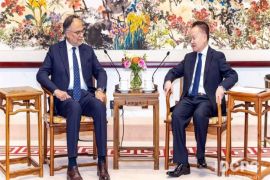
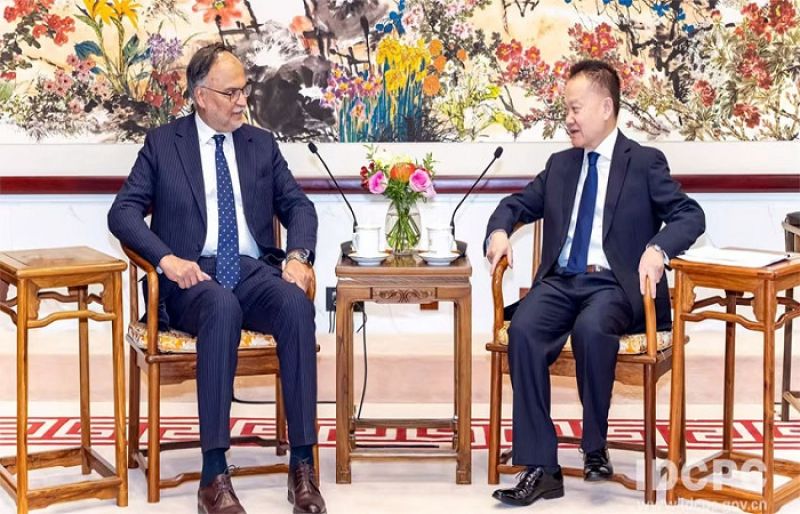
During a meeting with Minister of the International Department of the Communist Party of China (CPC) Central Committee (IDCPC) Liu Haixing, he pointed to tariff concessions China has extended to African countries as a possible model for improving the competitiveness of Pakistani exports.
The Minister for Planning also sought support for a proposed Pakistan–China Knowledge Corridor that would help about ten thousand Pakistani scholars pursue doctoral studies and specialised research over ten years. The proposal envisages scholarships, partnerships with leading Chinese universities and co-financing, with priority fields including artificial intelligence, engineering, advanced manufacturing, modern agriculture, biotechnology and mineral sciences.
Turning to the second phase of the China–Pakistan Economic Corridor (CPEC), Ahsan Iqbal highlighted industrial and agricultural cooperation, business partnerships, technology transfer, minerals and green development as priorities.
He said the first phase had attracted about twenty five billion dollars in investment, added more than 8,000 megawatts of generating capacity and delivered 888 kilometres of highways and motorways, while creating an estimated 236,000 direct and indirect jobs. He linked the next phase to Pakistan’s URAAN development programme and China’s 15th Five-Year Plan, underscoring the importance of policy continuity.
Ahsan Iqbal reaffirmed Pakistan’s commitment to the security of Chinese personnel and projects.
Meanwhile, Federal Minister for Planning, Development and Special Initiatives Professor Ahsan Iqbal held a meeting with Vice Chairman of China’s National Development and Reform Commission (NDRC) Zhou Haibing in Beijing.
The Minister for Planning sought early completion of the financing agreement for the 102-kilometre Thor Nullah–Raikot section of the Karakoram Highway.
He discussed Chinese participation in upgrading the ML-1 railway beyond Karachi–Rohri, for which Pakistan is exploring Asian Development Bank financing.
On Gwadar, Ahsan Iqbal sought support for restoring regular shipping services and proposed a joint study on strategic petroleum storage at the port. The talks also covered the Gwadar Free Zone, the second phase of the Eastbay Expressway and a proposed corridor linking Chagai’s mining areas to Gwadar for mineral processing and export.
Under the second phase of the China–Pakistan Economic Corridor (CPEC), Ahsan Iqbal sought progress on the Kohala and Azad Pattan hydropower projects and proposed joint work to assess whether selected power plants could switch from imported coal to local Thar coal. Pakistan proposed adding three private-sector projects to the CPEC industrial agenda: an aluminium complex at Port Qasim, a fertiliser plant in Thar and a refinery and fuel storage complex at Dhabeji.