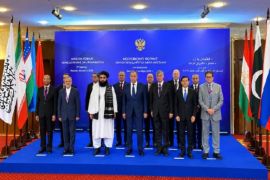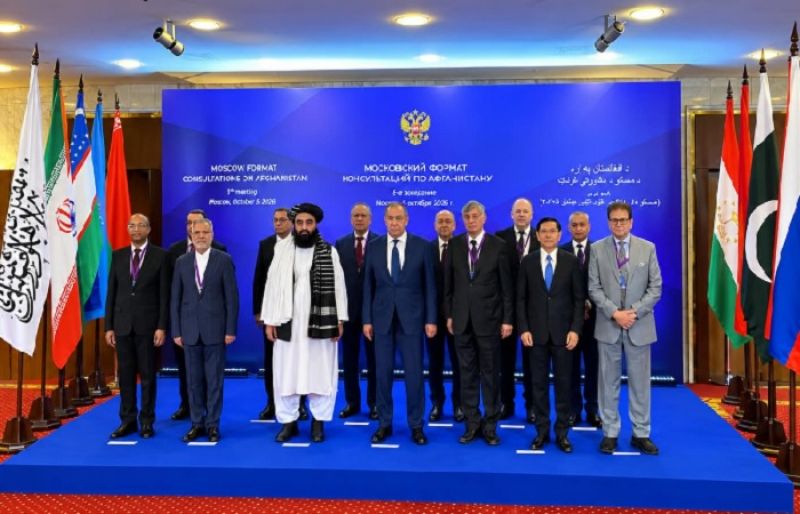
Pakistan participated in the eighth meeting of the Moscow Format Consultations on Afghanistan on Monday, with its special representative for Afghanistan, Mohammad Sadiq, telling the regional forum that terrorism remained at the core of Afghanistan’s problems.
The meeting brought together Afghanistan and countries of the region to discuss the situation in Afghanistan and wider regional concerns, with regional peace and security, counter-terrorism, economic cooperation, connectivity and continued engagement with Kabul among the key issues on the agenda.
Pakistan was represented by a high-level delegation led by Sadiq, Special Assistant to the Prime Minister and Special Representative for Afghanistan. The delegation also included Ambassador Faisal Niaz Tirmizi, Pakistan’s ambassador to Russia, and Ambassador Ubaidur Rehman Nizamani, Pakistan’s ambassador to Afghanistan, along with other senior officials.
In his address, Sadiq said terrorism emanating from Afghanistan remained a serious security threat to Pakistan. He attributed the problem to what he described as a nexus between the Taliban government and terrorist groups operating from Afghan soil.
Sadiq said Pakistan faced its most serious security threat five years into Taliban rule and said that more than 4,700 Pakistanis had been killed by terrorism emanating from Afghanistan over the past three years.
He said Pakistan’s counter-terrorism operations were being conducted in response to attacks from Afghan soil and described them as “precise, intelligence-based and defensive in nature”.
“Pakistan will continue to take all appropriate measures to uphold the safety and security of its citizens in accordance with international law,” Sadiq said, according to a transcript of his remarks.
He urged the Afghan authorities to end what Pakistan considers the continued operation of terrorist groups from Afghan territory, saying Islamabad wanted peace in the region and had remained engaged in political and diplomatic efforts.
Sadiq also said Pakistan expected the Taliban authorities to take “concrete and verifiable actions” against terrorist groups, arguing that the lack of progress on counter-terrorism commitments posed a threat to regional security.
At the same time, he stressed Pakistan’s interest in a peaceful and stable Afghanistan, saying peace and stability in the neighbouring country were in Pakistan’s national interest.
He said Pakistan had supported Afghanistan since the Taliban returned to power in August 2021 by facilitating humanitarian relief, providing visas to vulnerable Afghans, extending trade and transit incentives and participating in regional connectivity initiatives.
Russian Foreign Minister Sergey Lavrov attended the inaugural session and addressed the participating delegations. He said Moscow expected the consultations to contribute to Afghanistan’s development as an independent and stable state and to regional peace and stability.
The eighth Moscow Format meeting includes representatives from Afghanistan, China, India, Iran, Kazakhstan, Kyrgyzstan, Pakistan, Russia, Tajikistan and Uzbekistan, while Belarus and Egypt have been invited as guest countries.
The Moscow Format was established in 2016 as a Russia-led regional mechanism for consultations on Afghanistan.
The meeting comes amid strained relations between Pakistan and Afghanistan, with Islamabad repeatedly accusing the Taliban authorities of allowing the banned Tehreek-e-Taliban Pakistan (TTP) to operate from Afghan territory. Kabul has rejected the allegations and criticised Pakistani military action inside Afghanistan.
Recent tensions have included Pakistani airstrikes against what Islamabad described as terrorist hideouts in Afghanistan following a series of attacks and cross-border incidents.
Pakistan conducted calibrated strikes in September against militant hideouts and later carried out precision aerial and drone strikes at 10 locations in Afghanistan after drone incursions into Pakistani airspace.