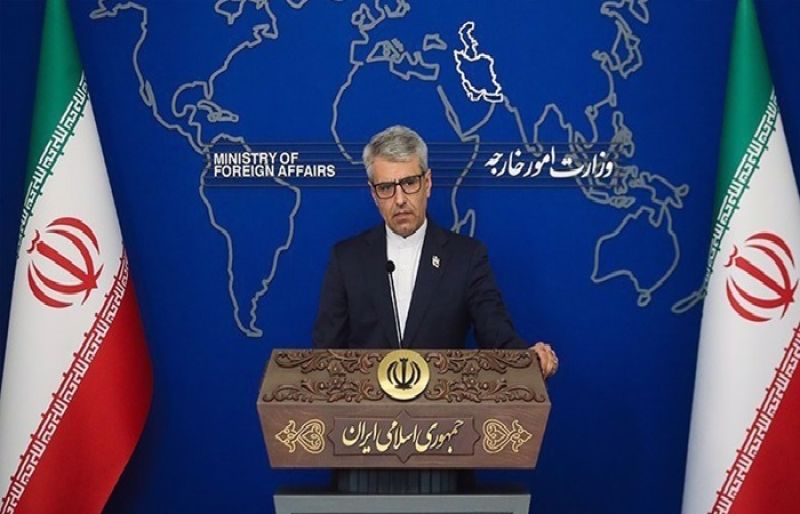
Iran will not allow the war to end on terms dictated by the party that initiated the aggression, Foreign Ministry spokesperson Esmaeil Baqaei says, stressing Tehran’s determination to defend its territorial integrity and national sovereignty.
Speaking at his weekly press conference on Monday, Baqaei said the officials of the Islamic Republic have spoken very clearly about the seriousness and determination to defend Iran’s territory.
Responding to a question from IRNA’s correspondent about President Masoud Pezeshkian’s recent remarks that it would be better to end the war while Iran is in a position of strength, he rejected interpretations suggesting that the remarks reflected a willingness to make concessions to the country’s enemies.
“We will show no leniency toward the aggressors, because … the Islamic Republic of Iran did not start the war and has defended its right, territorial integrity and national sovereignty. Naturally, the aggressor must be held accountable. We certainly did not start the war, but we will not allow the war to end on the terms of the aggressor,” he said.
Baqaei said President Pezeshkian had repeatedly made clear that Iranians would not surrender to coercion or domination by the foes.
He added that the administration and all branches of the Iranian state had acted “with one voice and in unity” to defend the country during the 40-day war and during the earlier 12-day war.
It is not logical to look at these issues in isolation, Baqaei said, emphasizing that there was no doubt about the Iranian leadership’s determination at all levels to defend the country and reject the aggressor’s excessive demands.
Targeting source of any aggressive action is Iran’s legal right
He also addressed reports in Western media about the possibility of US bases in European countries being targeted if hostilities resume, as well as reports that US KC-135 refueling aircraft had left Bulgaria.
He explained that Iran had previously made its position on Bulgaria clear and confirmed that Tehran had heard reports that several US refueling aircraft had departed the country.
“From the outset, as many people and politicians in Bulgaria itself had stated, this action was contrary to international law, because we have no problem with the people of Bulgaria and this was, in a way, considered support for the military aggression of the United States and the Zionist regime against Iran,” he said.
Baqaei argued that countries allowing their bases, facilities and equipment to be used by the United States and Israel for military action against Iran could be regarded as participating in an act of aggression under international law.
“We hope that other countries that have in some way made their bases and facilities available to the United States and the Zionist regime to commit the crime of aggression against a member state of the United Nations will also take the necessary action,” he said.
The Iranian spokesperson said countries had no reason to be concerned about possible Iranian action unless they allowed their bases, facilities, or equipment to be used for unlawful acts by the aggressors.
“It is Iran’s right to target the source and origin of any act of aggression against the Islamic Republic of Iran. This is part of international law, and as we have shown, in defending the existence of Iran, we will certainly show no leniency,” he said.
Baqaei also highlighted the Foreign Ministry’s efforts to reform its administrative system, saying measures had been underway since June 2025 in accordance with a 17-point directive.
He said a committee had been established under the ministry’s deputy for administrative and financial affairs, with representatives from relevant departments, to strengthen procedures and improve performance.
According to Baqaei, the reforms had produced tangible results in several areas, particularly consular services. He pointed to services provided to Iranian pilgrims during the Arbaeen pilgrimage, including visa-related and other consular services.
The spokesperson said the ministry had carried out its diplomatic responsibilities under particularly difficult circumstances during the past year and a half.
“We have faced special conditions arising from two imposed wars by the United States and the Zionist regime during this one year to one year and a half, and the Foreign Ministry has in a way advanced diplomacy under conditions of war and crisis,” he said.
Baqaei was also asked about reports that Iran had been offered membership in a proposed trilateral defense arrangement involving Pakistan, Saudi Arabia, and Turkiye, which he denied.
“We have not received an official invitation in this regard,” he said, adding that proposals raised by regional countries had so far focused on dialogue and consultations concerning collective security issues in the region.